How Much Does a Website Cost for a Local Business? (With Real Examples)
The cost of a website for a local business is the first question every shop owner, restaurant manager, or professional office asks when they decide to go online. The problem? Ask three developers for a quote and you'll get three wildly different numbers: $800, $3,000, $12,000. It feels like there are no rules. There are rules, actually — and once you know them, it becomes easy to tell whether a quote is fair, inflated, or suspiciously cheap. In this guide, I'll show you the real price ranges for each type of local business, what you should expect at each level, and how to avoid getting ripped off. If you run a restaurant, a law office, a retail shop, or a craft workshop , you'll find concrete numbers here — not the usual "it depends on your needs" non-answers.
How much does a website really cost for a local business: the real tiers
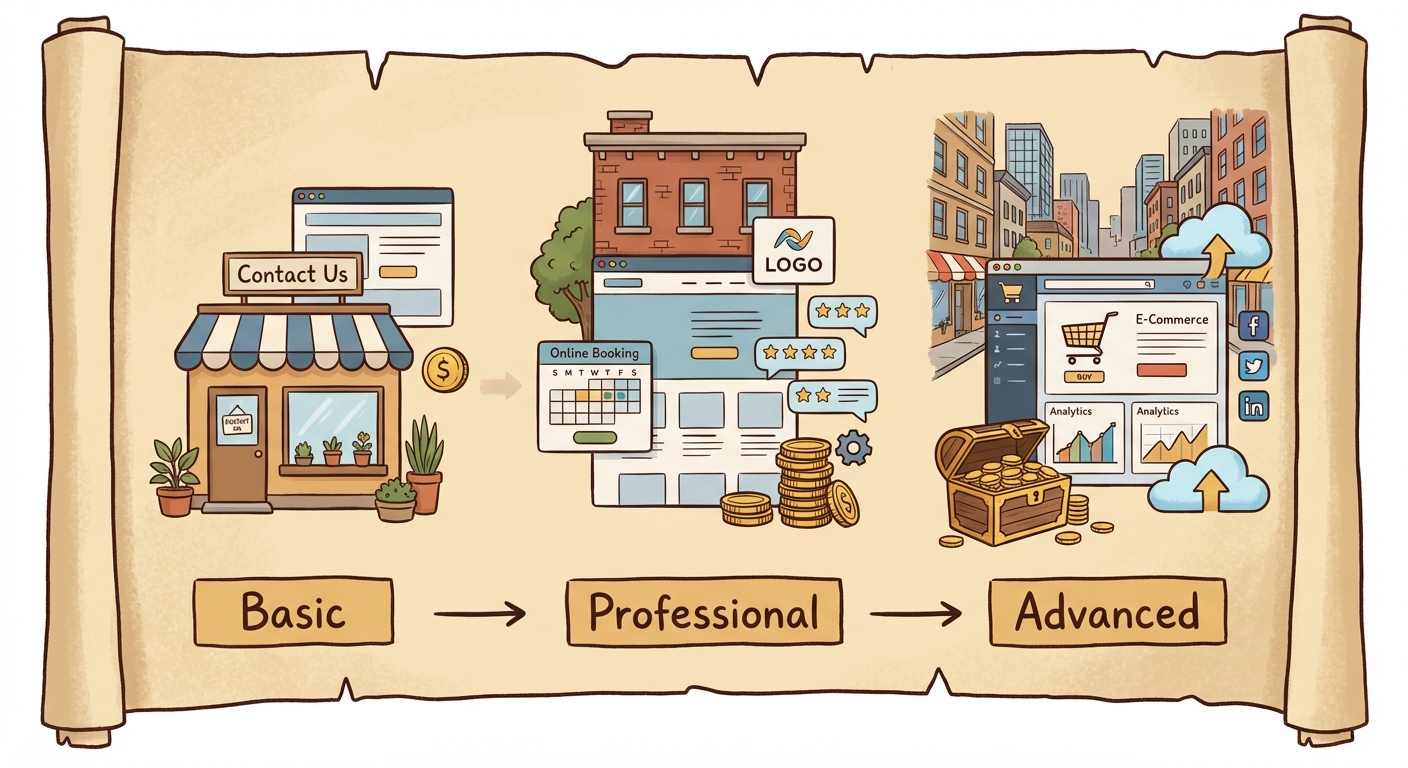
A website for a local business in the US typically costs between $1,500 and $5,000 for the initial build. The range depends on the number of pages, the level of custom design, and the features you need. On top of that, expect annual recurring costs between $200 and $800.
Here are the three main tiers and what you can expect from each.
Basic brochure website ($1,500–$3,000). This is the starting point for businesses that want a clean, functional online presence. It includes 4-6 pages (home, about, services, contact), a professional template customized to your brand, a contact form, Google Maps integration, and basic search engine setup. It's the right choice if you're starting from scratch and want to be found by people who already know your business or search your name on Google.
Professional website with strategy ($3,000–$5,000). At this level, your website isn't just a digital business card — it's a tool designed to bring in new customers. Beyond everything in the basic tier, you get more custom design work, copy written to convert (not just inform), structured SEO optimization, a blog or news section, and features specific to your industry (table reservations, appointment booking, product catalog). If you want your website working for you even when you're closed, this is the tier to consider.
Website with advanced features ($5,000+). For businesses with more complex needs: e-commerce with order management, customer portals, integration with business management software or payment systems, multilingual support. The price scales with technical complexity.
For a deeper look at all pricing tiers, including e-commerce and corporate sites, read my complete guide on how much a website costs.
Here's the key takeaway though.
Most local businesses — restaurants, professional offices, shops, artisans — fall into the first or second tier. You don't need a $15,000 website to get real results. You need a well-built website designed for your specific type of customer.
Website cost by industry: 5 real examples
Generic price ranges only get you so far. What you really want to know is: how much should I invest for my business's website? Here are five real-world examples with what each website should include and the price range you can expect.
Website for a restaurant or bar
Range: $2,000–$4,000
A restaurant needs a website that makes people hungry. Literally. Professional food photography, a browsable menu (not a downloadable PDF — nobody opens those on a phone), updated hours, a map with directions, and ideally an online reservation system.
What it should include: a homepage with impactful images, a menu page you can update yourself, an "about us" section with the story behind the place, a photo gallery, contact details with an interactive map, links to social profiles and Google reviews. If you add integrated table reservations, the cost goes up by $500-800 but the return is immediate.
The restaurant website is one where photo quality makes the difference between "booking now" and "scrolling past." Save money on other things, not on the images.
For a dedicated breakdown of features and costs, I've written an in-depth article on websites for restaurants.
Website for a professional office (lawyer, accountant, doctor)
Range: $2,500–$5,000
For a professional, the website must communicate competence and trustworthiness. Visitors arrive with a problem and need to find confirmation within seconds that you can solve it. No flashy effects needed: clear copy, clean structure, contact details always visible.
What it should include: a dedicated page for each service offered (not a generic list, but a page for each area of expertise), an "about me" section with a professional photo and background, a contact page with a form and option to book an appointment, and optionally a blog with informational articles for potential clients. For a medical practice, add online appointment booking.
The blog isn't an extra here — it's the tool that gets you found on Google when someone searches "lawyer specializing in [your field] near [your city]." Informational articles are the foundation of local search visibility.
Website for a retail shop
Range: $1,500–$3,500
A physical store's website needs to do one simple thing: convince people searching online to visit in person. It's not an e-commerce site (that's a different conversation and a different budget) — it's an evolved business card that shows what you carry, where you are, and why it's worth stopping by.
What it should include: a photo catalog of your products or categories (you don't need a page for every item, just enough to show what you offer), updated opening hours, a map with directions, direct contact options (clickable phone number, WhatsApp), and any current promotions or new arrivals featured prominently.
If you plan to add online sales later, make sure the site is built on a technical foundation that allows this expansion without starting over from scratch.
Website for an artisan or craftsperson
Range: $1,500–$3,000
An artisan sells with their hands and with images of their work. The website should be a showcase of completed projects — a visual portfolio that speaks for itself. Minimal text, lots of photos, simple contact options.
What it should include: a gallery organized by project category, an "about me" page with the story and philosophy of the workshop, a services page (what you do and for whom), and contact details with a form and phone number. If you work on commission, a custom quote request form adds real value.
At this price point, the site can be lean (4-5 pages) but it must load fast and look flawless on a smartphone — because the majority of your potential customers will find you on their phone.
Website for a B&B or guesthouse
Range: $2,500–$4,500
Tourism lives and dies by images and bookings. A B&B's website needs to make visitors dream and make it effortless to book. Photos are everything: rooms, common areas, the surrounding landscape, breakfast. If the photos are bad, the website doesn't work. Period.
What it should include: a professional photo gallery, room descriptions with prices and availability, a booking system (even a simple connection to Booking.com or a dedicated form), a "things to do nearby" section (great for local SEO), guest reviews, and detailed directions.
Here's the thing.
For a B&B in the countryside or in any tourist area, the website is often the very first touchpoint with a potential guest. If the online experience disappoints, the guest never arrives for the in-person one.
The cost components you need to know (and the ones they hide from you)
The initial build price is only part of the total cost. There are recurring expenses and line items that many developers conveniently forget to mention in their quotes. Better to know upfront.
One-time costs: development, design, content
What you pay once includes: site structure planning, graphic design, technical development, content insertion (text, photos, logos), basic SEO configuration, cross-device testing, and launch. If you provide the copy and photos yourself, the cost drops. If you need them produced, add $500-1,200 for a copywriter and $300-800 for a basic photo shoot.
Recurring costs: hosting, domain, maintenance
Every year you'll need to renew your domain (your site's name, like yourbusiness.com) and hosting (the server space where your site lives). For a small business site, that's around $150-300 per year total. If you add a maintenance and technical support plan, annual costs rise to $500-1,200, but you get the peace of mind that someone handles updates, backups, and technical issues.
Hidden costs: updates, security, compliance
Here are the line items that don't appear in many quotes but will eventually show up:
SSL certificate (the padlock icon in the browser): often included with hosting, but verify. Cookie consent banner and privacy policy: there are online services for $50-150/year, or your developer sets it up during the build. Security updates: an unmaintained site is a vulnerable site. If you can't handle it yourself, you need a maintenance plan. Professional email on your domain (like info@yourrestaurant.com): $25-75/year per mailbox.
None of these costs are huge, but if you don't budget for them you'll face unpleasant surprises at the first renewal.
Freelancer, agency, or DIY: what works best for a local business
This is the question that makes the biggest difference on the quote. The same business, the same type of website, can cost very different amounts depending on who builds it.
DIY | Freelancer | Agency | |
|---|---|---|---|
Typical cost | $0-500 + your time | $1,500-5,000 | $5,000-15,000+ |
Time to launch | 2-8 weeks (if learning from scratch) | 2-4 weeks | 4-8 weeks |
Customization | Limited to templates | High | Very high |
SEO | Basic or absent | Included (if the freelancer knows SEO) | Included, often with strategy |
Post-launch support | Online communities | Direct, personal | Structured, with tickets |
Best for | Testing, hobby projects | Small businesses, professionals | Established SMBs, complex projects |
For a local business with a moderate budget, a freelancer is almost always the best value for money. You pay less than an agency's overhead, but you get a dedicated professional who knows your project and gives you personal attention.
DIY platforms like Wix or Squarespace seem affordable, but they have real limitations on customization, SEO, and scalability. If the website is a core asset for your business (and for a local business, it almost always is), the upfront savings can cost you dearly later. I go into this in detail in DIY website: is it really worth it?
The truth is.
There's no one-size-fits-all answer. But for most small local businesses — restaurants, shops, professional offices, craftspeople — a freelancer with experience in web development and local SEO is the most practical choice.
Is your website a cost or an investment? How to calculate it
Let's talk about the numbers that actually matter.
Imagine you run a dental practice. A new patient is worth, on average, several hundred dollars over the course of the professional relationship. If your website, thanks to good Google visibility and a well-designed page, brings you even just 2-3 new patients per month, you've generated value in one year that far exceeds the cost of the website.
The same logic applies to a restaurant. If the website with its reservation system brings in 5 extra covers per week, by the end of the month you have additional revenue that covers the website cost within a few months.
The calculation is simple: take the average value of a new customer for your business, multiply by the number of customers the website can bring you in a year, and compare that to the total cost (development + annual expenses). In most cases, the website pays for itself within the first 6-12 months — provided it's built to bring customers, not just to "be online."
If your current website isn't delivering results, the issue might be strategy, not budget. I've written a specific guide: your website isn't bringing clients? here's why and how to fix it.
Want to understand how a custom website could work for your business? Take a look at my services and let's talk.
5 red flags in a website quote
When you receive a quote, there are signals that should set off alarm bells. You don't need technical expertise to spot them — you just need to know what to look for.
The domain isn't registered in your name. If the developer or agency registers the domain under their name, you're locked in with them. The domain (yourbusiness.com) must be your property. Always. Ask explicitly: "will the domain be registered in my name?"
No mention of SEO. A website without search engine optimization is like a beautiful store on a dead-end street. If there's not a single line about SEO in the quote, ask why. It might not be included (and you'll pay separately) or, worse, it might not be planned at all.
Suspiciously low price with no explanation. A $500 website exists, but it's a $500 website. At that price, you can't have custom design, professional copy, optimization, testing, and support. If the price seems too good to be true, it probably is.
No maintenance plan. A website isn't a finished product you buy and forget. It needs maintenance, updates, backups. If the quote doesn't mention post-launch support, ask what happens after delivery.
Unrealistic timelines. A professional website takes time: analysis, design, development, testing, content. Anyone promising a site in 3 days is probably slapping your logo on a template. That might work for a quick test, but not for a site that needs to bring in customers.
For more detail on what to look for in a quote and how to read each line item, check out the guide on how to read a website quote.
Checklist: what your local business website must include
Regardless of your industry, there are elements every local business website needs. Use this as a reference when evaluating a quote or checking whether your current site is complete.
Essential (non-negotiable):
Responsive design (works well on smartphone, tablet, and desktop)
Load time under 3 seconds
Active SSL certificate (the padlock in the browser)
Business name, address, phone number, and hours always visible (ideally on every page, in the footer)
Working contact form with email notification
An "about us" page with a real photo and the business story
Updated Google Business Profile connection
Privacy policy and cookie consent compliant with regulations
Optimized meta title and description for every page
Important (make a real difference):
Interactive map with directions
Click-to-call button on mobile
Links to active social profiles
Reviews or testimonials section
Copy written with the customer in mind, not the business owner
Extra (for those who want more):
Blog with informational articles (essential for SEO)
Online reservation or appointment booking system
Integrated WhatsApp chat
Work gallery / portfolio / digital menu
Newsletter integration to build customer loyalty
If your current website is missing more than half of the "essential" items, it might be time for an upgrade.
Frequently asked questions
How much does a website cost for a retail shop?
A website for a physical retail shop costs between $1,500 and $3,500 for a brochure-style site with product photos, hours, contact details, and a map. If you want to add e-commerce functionality, the budget rises to $5,000-$10,000 and up, because you need product management, shopping cart, and payment processing.
How much does a website cost for a restaurant?
A professional restaurant website with a digital menu, photo gallery, contact info, and a map costs between $2,000 and $4,000. If you add an integrated table reservation system, expect an additional $500-800. Professional food photography isn't included in the website cost but is an investment I always recommend.
How much does it cost to maintain a website per year?
The minimum annual costs for a local business website are: domain ($10-20/year), hosting ($100-200/year), and basic maintenance — updates, backups, security ($300-700/year if handled by a professional). Total: roughly $410-920/year, depending on the level of support.
Should I build my own website with Wix or Squarespace?
For an initial test or a hobby business, it can make sense. For a local business that wants to be found on Google and attract customers, DIY platforms have significant limitations: reduced customization, limited SEO capabilities, and difficulty scaling over time. The risk is spending $200 and months of your time on a result that doesn't deliver.
How long does it take to build a website for a local business?
A 4-6 page brochure site typically takes 2-4 weeks from the moment you've provided all materials (copy, photos, logo). A more complex site with custom features can take 4-8 weeks. The most common bottleneck? Content. If the text and photos arrive late, the entire project slows down.
How do I know if a website quote is fair?
Check that the quote clearly includes: number of pages, what's covered in the design, whether copy and photos are included, domain ownership, whether hosting and maintenance are covered, and what happens after delivery. A fair quote doesn't hide items — it lists them all.
Thinking about a website for your business? Get in touch — I'll tell you exactly what it would cost in your case, straight talk and no commitment.
Comments
Be the first to share your thoughts!
No comments yet
Be the first to share your thoughts!
Share your thoughts
Log in to comment on this post.
Log in to comment on this post.